BYD builds complete battery-electric buses and trucks, from its own lithium iron phosphate cells to the motors at the wheels. It is a useful benchmark for how much battery a heavy vehicle needs, but it does not sell its drivetrain as parts for retrofits.
System
BYD
Type
Complete electric vehicle
Keeps C12 + MH 4000?
No
Battery (supplier)
422–563 kWh LFP (BYD)
High voltage
Not public
Sold for retrofit?
No
Coach fit
Very low
Tested against a 2002 Country Coach Magna: 40 ft, tag axle, Cat C12 (about 425–505 hp, up to about 1,550 lb-ft) and an Allison MH 4000.
In plain terms
What BYD offers, and why it matters for a coach
BYD is one of the largest battery makers in the world and one of the few companies that designs the cells, packs, motors and controls of its vehicles in house. In North America its buses and trucks are assembled in Lancaster, California, now under the RIDE brand.
Its vehicles are purely battery-electric. There is no engine to fall back on, so range is set by the size of the pack and by access to charging. The 8TT Class 8 tractor carries 422 or 563 kWh, and K-series transit buses carry roughly 100 to 600 kWh depending on length. Those numbers show the scale of battery a pure-electric 40-ft coach would need, and the weight that comes with it.
BYD’s early US record is mixed. Independent reports document strong operating-cost savings in Los Angeles, alongside a suspended demonstration and a rejected fleet elsewhere. For a coach conversion the bigger obstacle is simpler: we found no evidence that BYD sells its axles, motors or packs to retrofitters in the US.
01 · How it works
How it works
Whole electric vehicles, battery to wheels, all BYD
BYD builds complete battery-electric buses and trucks, including its own lithium iron phosphate (LFP) cells and packs, motors and controls. North American models are assembled in Lancaster, California, now under the RIDE brand. There is no engine, so range depends entirely on charging.
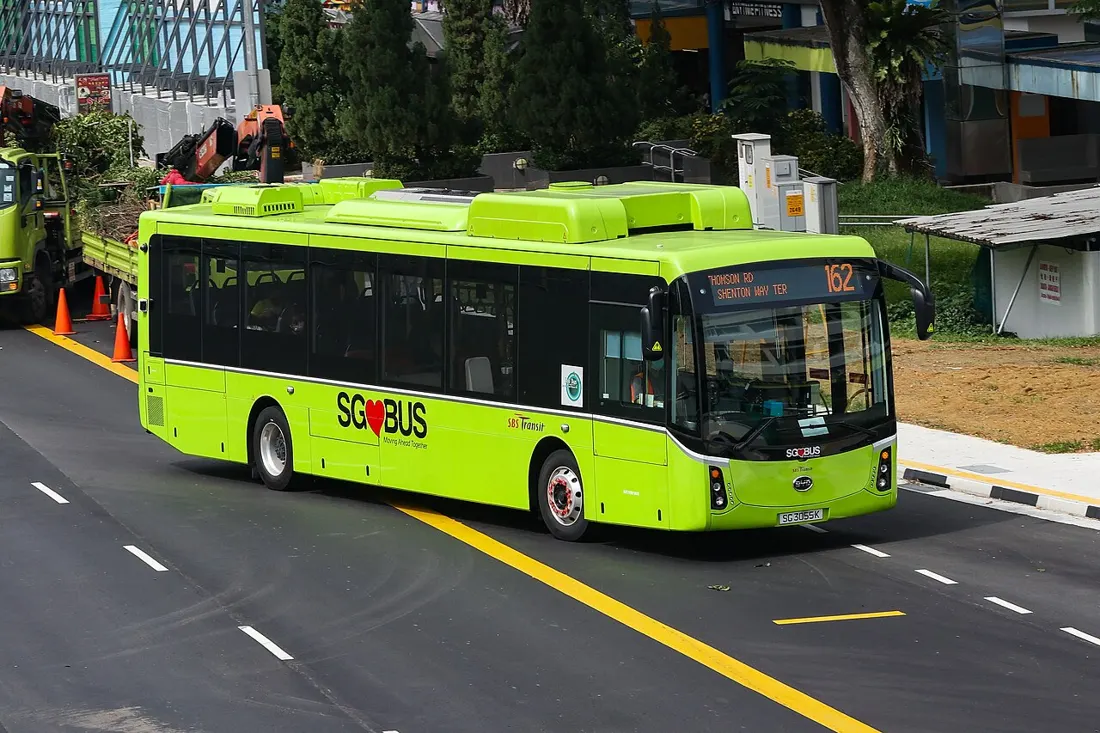
K-series transit buses: a motor and reduction gear at each rear drive wheel. Axle options 2 × 90 kW, 2 × 150 kW or 2 × 180 kW (2 × 1,500 N·m). Packs roughly 100–600 kWh depending on length.
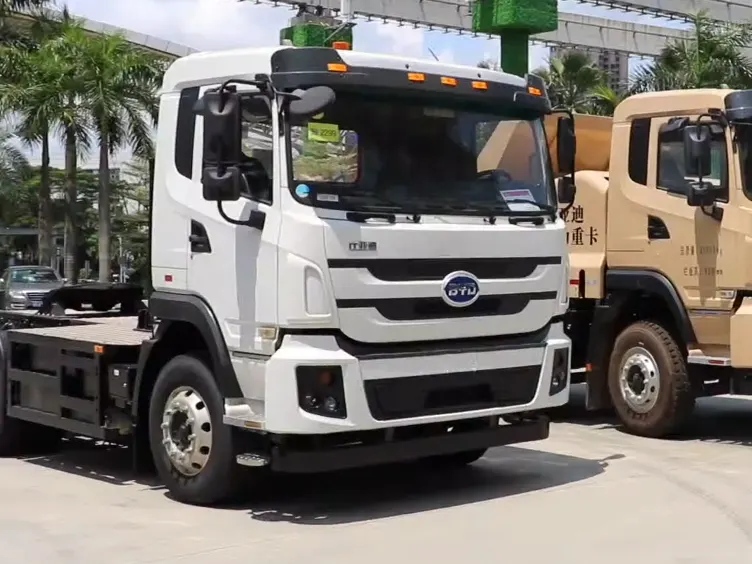
8TT Class 8 tractor: 422 kWh (150+ mi) or 563 kWh (200+ mi) LFP, DC charging 130–230 kW, 82,000 lb GCWR. Curb weight 26,040 / 28,913 lb.
BYD markets its newer LFP cells as “Blade” batteries.
BYD 8TT electric tractor in Shenzhen. Image: Vincent Everts, Wikimedia Commons, CC BY 3.0.
Huge battery maker, mixed early US record, no retrofit parts
Advantages
Vertically integrated: BYD designs its own cells, packs and motors, and is one of the world’s largest battery makers.
Independent A California Energy Commission study of LADOT’s BYD buses found operating costs about one-third of CNG buses.
LFP chemistry: long cycle life and good thermal stability.
Disadvantages
Independent LA Metro suspended its BYD bus demonstration in 2016 over range, hill climbing and reliability; Albuquerque rejected its BYD buses in 2018 (177 mi vs 275 promised, brake, door and battery-case issues).
No engine: range is bounded by the pack; a coach would need hundreds of kWh.
Parts, software and service are tied to one company.
We found no evidence BYD sells its axles, motors or packs to retrofitters in the US. It is useful as a benchmark for pack size and weight.
The practical takeaway: BYD is a reference point for pack size, weight and charging rather than a supplier. A pure battery-electric Magna would need hundreds of kWh in the basement and engine bay, which is why a series hybrid with a smaller shared pack and a genset is the more realistic layout.
04 · Maintenance
Maintenance
No oil changes, filters or exhaust after-treatment; the battery cooling and charger systems become the critical items.
Independent LADOT’s buses had a recurring charger cooling-system fault and a cracked battery-pack cover that let water into the battery.
Warranties seen: 12-year battery to 70% capacity and 5-year/350,000-mile propulsion (LADOT buses); 8-year battery on the 8TT.
Parts and service through BYD/RIDE; independent dealer coverage for retrofits Not public. High-voltage training required.
BYD K9 electric bus (Singapore). Photo: boy_yo, Wikimedia Commons, CC BY-SA 4.0.
What a conversion would involve in a 40-ft, tag-axle diesel pusher such as a 2002 Country Coach Magna (Cat C12, Allison MH 4000). Figures are only given where a source publishes them.
Space: a pure-electric coach would fill the engine bay and much of the basement storage with battery.
Weight: the 8TT’s extra 141 kWh adds 2,873 lb (about 20 lb/kWh). A 300–500 kWh pure-electric coach pack would be roughly 3–5 tons Estimate.
Electrical: HV pack voltage Not public; DC fast charging up to 230 kW on the 8TT.
Labor: not offered as a retrofit, so Not public.
06 · 12 V house power & coach batteries
12 V house power & coach batteries
Big LFP packs could run a coach, but BYD doesn’t sell them for it
12/24 V from high voltage
Like other battery-electric vehicles, BYD’s make low-voltage power with an onboard DC-DC converter instead of an alternator; ratings Not public. Off-the-shelf converters exist from others (Eaton: 3–5 kW at 12 V, 5–10 kW at 24 V).
Traction pack as house bank?
LFP tolerates deep, daily cycling better than most chemistries, which is why a shared pack is attractive. The cons: every kWh used camping is range lost; the HV pack must be awake (contactors closed, BMS running) to feed loads, which adds standby draw; and the coach still needs an isolated 12 V battery for starting and safety systems. Estimate a 3-day boondock at 10–15 kWh/day uses 30–45 kWh.
AC power & inverters
No BYD 120/240 V export product found for North America Not public. A coach build would need an HV-input or low-voltage inverter of roughly 6–10 kW Estimate, plus shore power routed to the HV charger.
Sources: Eaton HV DC/DC data sheet · consumption ranges are typical engineering values, not BYD data.
07 · Cost of ownership
Cost of ownership
Independent the LADOT buses cost $778,000 each; the study estimated about a 10-year payback. 8TT price Not public; California HVIP vouchers are $120,000 ($150,000 for drayage).
08 · Battery & supplier
Battery & supplier
BYD’s own LFP (Blade on newer models): 422 or 563 kWh in the 8TT; about 100–600 kWh in K-series buses.
09 · How it compares
How it compares
BYD in the side-by-side table. The full table, including the parallel PTO add-on, is on the overview.
System
Type
Keeps C12 + MH 4000?
Battery (supplier)
HV
12/24 V & AC power
Sold for retrofit?
Coach fit
BYD
Complete electric vehicle
No
422–563 kWh LFP (BYD)
Not public
Not public
No
Very low
10 · Sources & credits
Sources & credits
Every figure on this page links back to one of these. Labels:
Maker claim what the manufacturer says
Independent government test, public record or trade press
Estimate typical engineering range, not a measured figure
Diagrams are original and simplified, based on the manufacturers’ published specifications. Photo credits and licenses appear under each image. Research compiled October 23, 2026; specifications, prices and availability change.